
Affordability is Still Everything
The majority of political commentators (including myself) continue to underestimate its importance

On Monday, Donald Trump hit his lowest approval number of the second term.
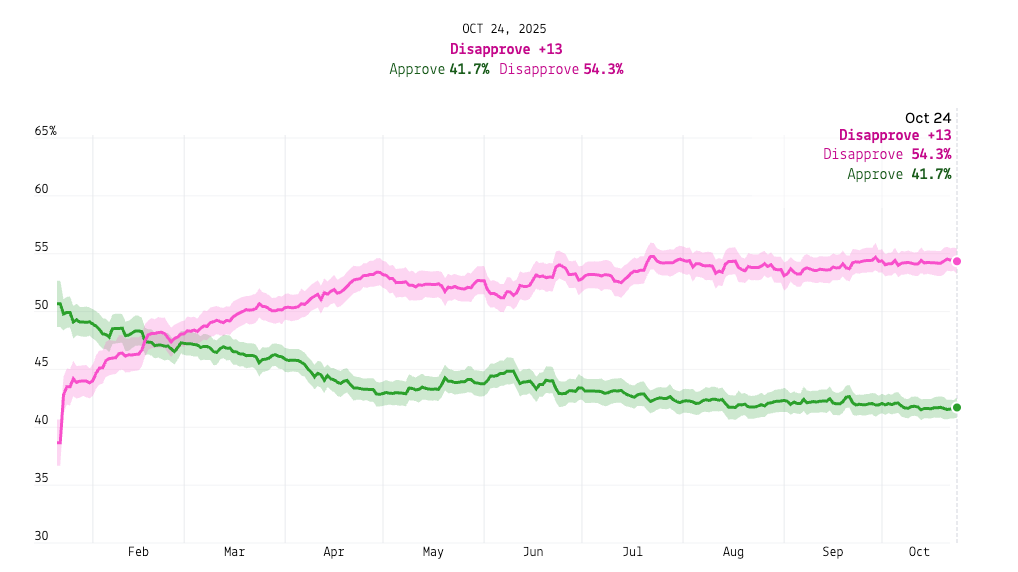
This surprised me a bit, because in my view, the prior week was relatively good for Trump (with relative doing a lot of work there), most notably: the Gaza “ceasefire” getting overwhelmingly and uncritically effusive praise from many in the media. Nevertheless, Trump’s approval rating continued its slow decline.
This paradox got me thinking, what am I under and overestimating in the political economy?
For one, I am clearly overestimating the importance (to most Americans) of international conflicts, like the war in Gaza. I personally was happy with even this flimsy ceasefire. Anything to stop the carnage in Gaza is a positive development.
Furthermore, if you are online, Israel, the Palestinians, Gaza, and all the interrelated topics from anti-Semitism to student protests are constantly part of the political discussion. The reality, however, is that since inflation rose following the pandemic, economic and cost-of-living issues have and continue to be the most pressing concern for voters. For most voters, international issues only play a minor, secondary role.
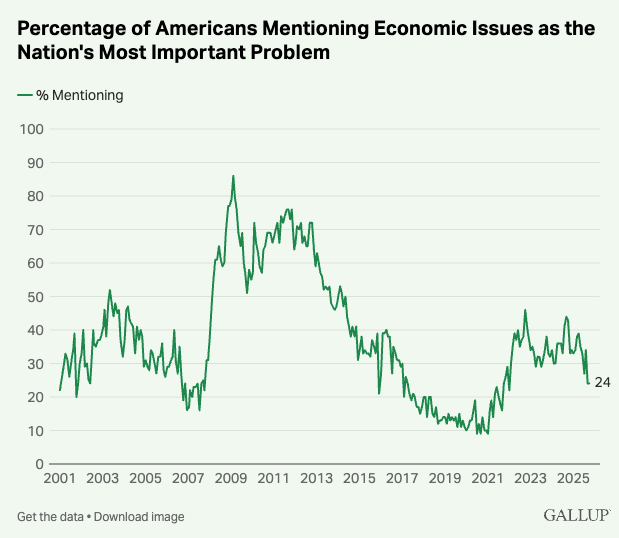
The political economy has been stuck for years in an affordability-centered logjam. The Biden Administration massively failed on cost-of-living issues. This was the central driver of Joe Biden’s dismal approval ratings.
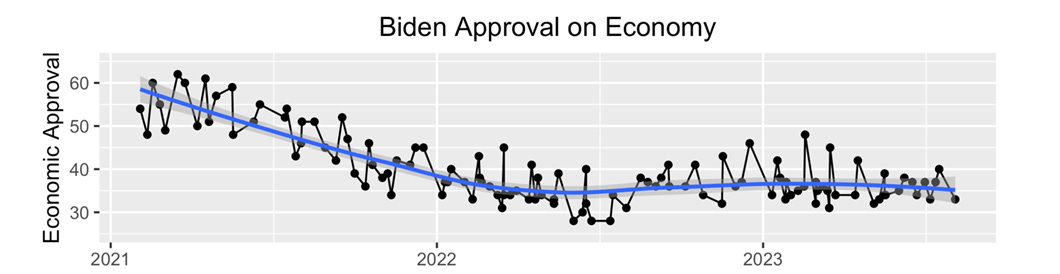
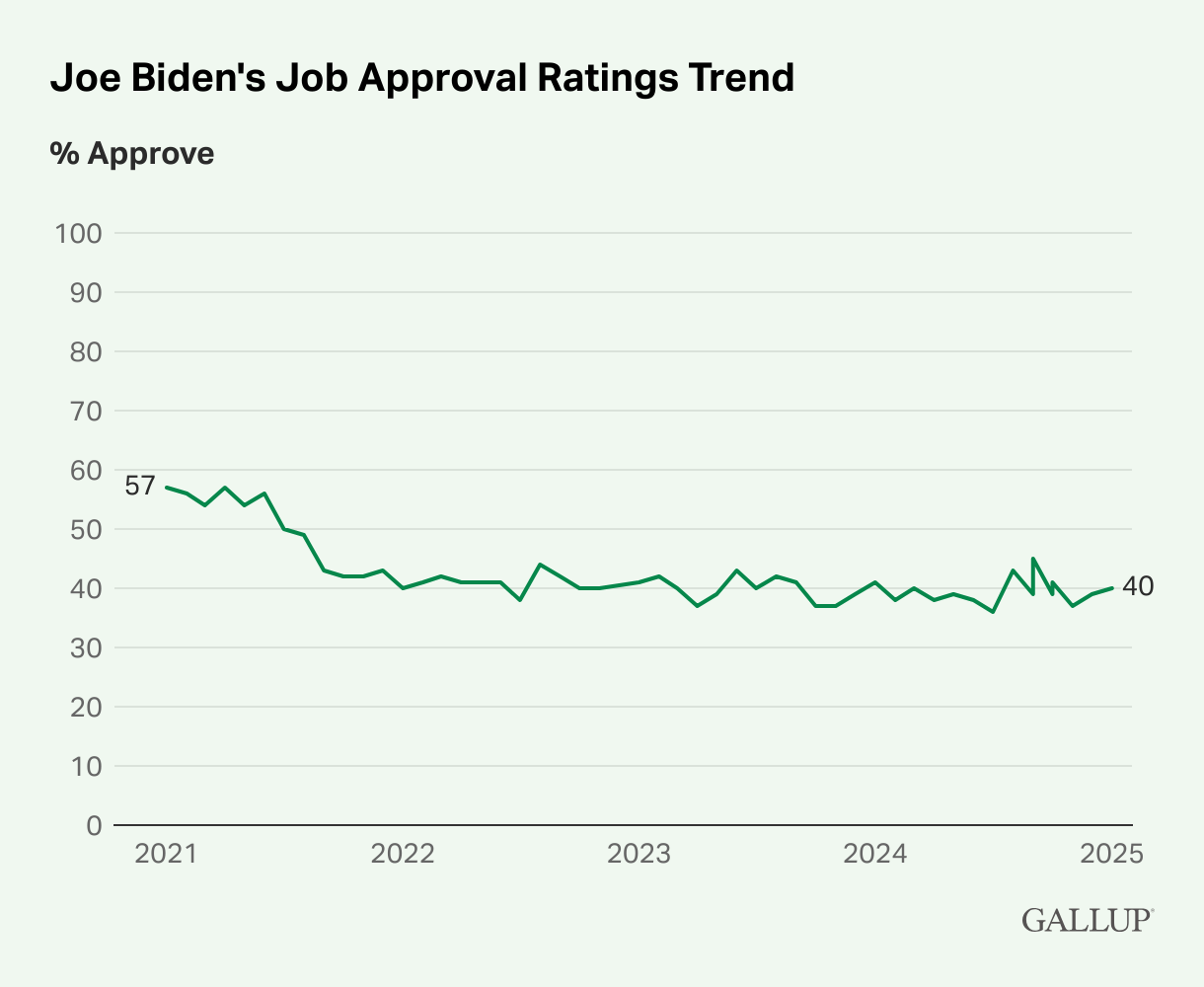
Once again, the online political class got involved in all sorts of various discussions about why Biden was unpopular: Gaza, his age (this is why he could not run for a second term, not why he was unpopular), COVID lockdowns, Afghanistan, which all missed the mark. Joe Biden became unpopular because the cost of everything rose, and he was unable (partly due to age) and at times seemed unwilling to handle it (talking about NATO all the time certainly did not help).
Now, to be honest, I wish this were not the case. To those of us who study these issues, the president only has limited control over the cost of goods.
The 2024 election and aftermath
I will spend as little time as possible re-litigating the awful outcome of the 2024 election. Donald Trump won the election and won because voters were most concerned with economic issues and felt he could better handle them.
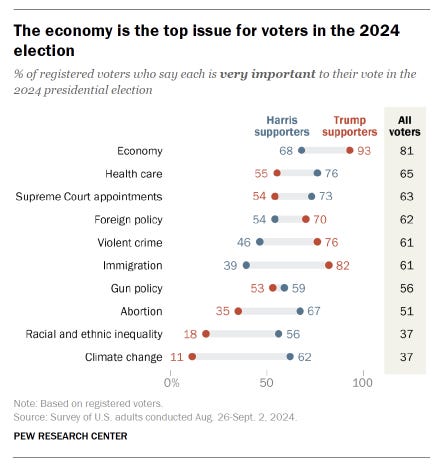
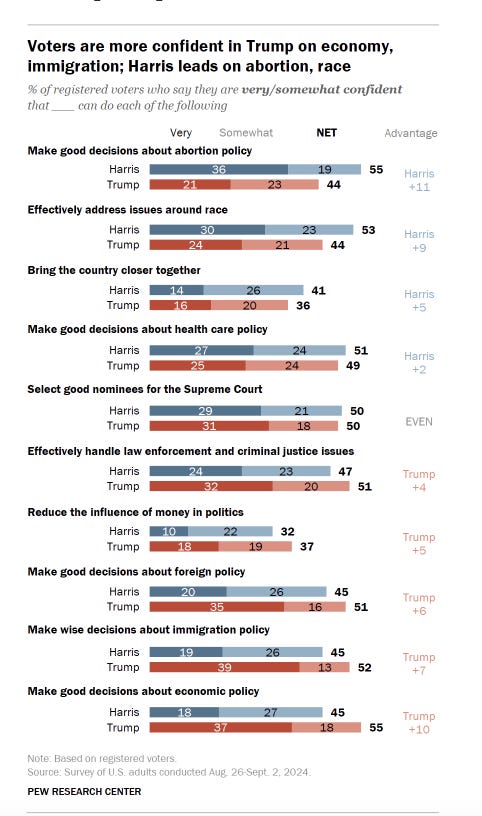
This was in part due to Trump saying (lying, because it is out of his control), that he was going to lower grocery prices on day one, and constantly attacking the Biden Administration and Kamala Harris on cost-of-living issues. I would note that again, this did not stop the political class from making all sorts of other arguments about why Trump won: the most common and notable being how Trump “won” the culture.
If you read the (second) chart from Pew, Kamala Harris was trusted on race and abortion MORE than Donald Trump was trusted on immigration. This is not an argument for Democrats to avoid moderating on cultural issues; I generally support that, just analytically, cultural explanations do not explain the results of the 2024 election. Donald Trump won gettable voters concerned about affordability and cost-of-living issues and thus won the election.
Furthermore, besides winning with voters most concerned about the economy, there was a 15% swing towards Trump from voters making less than $50,000. I thought Kamala Harris ran a great campaign, but unless she had been able to separate herself from Biden on cost-of-living issues, she basically had little chance in the election.
The Government Shutdown
The theme of this post so far is that all of us who write and think about politics are still underestimating cost-of-living and affordability issues. This is in part because the people who are struggling to get by spend a lot less time talking about politics.
This analytical miss also heavily impacted expectations and reality when it came to the government shutdown. I had hoped the Democratic Party would shut down over the broader illegal actions of the Trump Administration, notably the masked ICE agents terrorizing our communities. When I found it was going to be over health care subsidies, I felt like once again Democrats were going to miss the moment.
Furthermore, I agreed with commentators that by bringing a new issue into the funding fight, Democrats were probably deserving of blame for the shutdown. My own view was obviously that Democrats were shutting down the government, but they needed to do it to fight against the blatant illegality of the Trump Administration.
Yet somehow, Democrats have won the shutdown. In every single poll, Republicans are being blamed more for the shutdown. More importantly, 78% of Americans are on the Democrats’ side for the key issue of extending the Obamacare subsidies. The Democrats have raised salience on an 80-20% issue without taking blame for the shutdown. That is an incredible outcome.
I will put it another way: Chuck Schumer and Hakeem Jeffries were right, healthcare premiums are about to skyrocket, and Republicans are uninterested in helping people in a political environment where everyone is already furious over costs. This was the exact right fight to have. I do not think you can seperate the popularity of the issue from the blame. I would argue that voters are on the side of the Democrats, and that is why Republicans are being blamed.
Concluding thoughts
Now my biggest problem with mainstream Democrats is that they do not have a compelling story on costs and affordability. In essence, they are right on their diagnosis but wrong on their piecemeal and often underwhelming solutions. Bernie Sanders certainly has a message on the cost-of-living and affordability crisis. The billionaires and corporations are screwing everyone over, and every affordability issue can be tied back to their greed. The lack of a narrative for mainstream Democrats is a big reason why they are still extremely unpopular despite clearly having the better policies to address the affordability crisis.
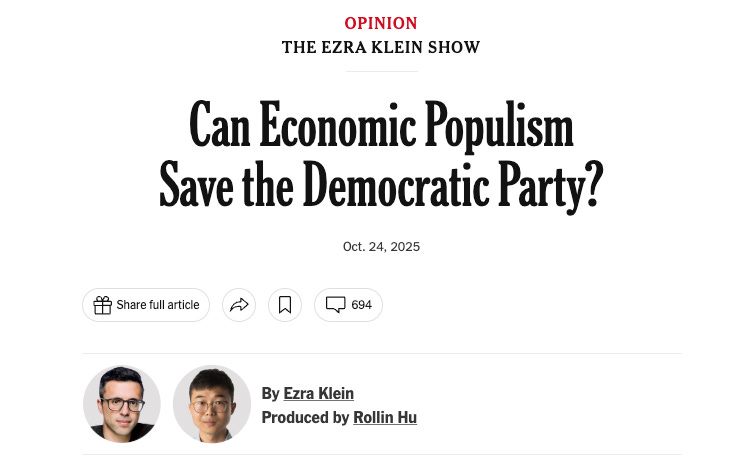
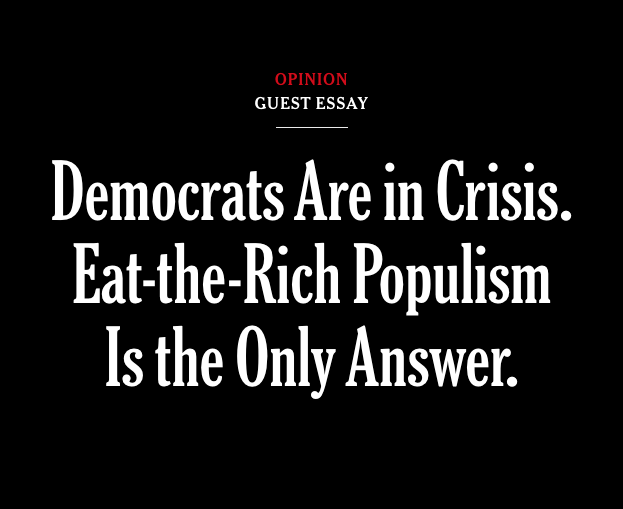
In this case, I think the obvious answer is for everyone to just be Bernie-light mini economic populists. I think mainstream Democrats are starting to understand this as well, as evidenced by the turn in their (mainstream Dems) bible, the New York Times (there was more, but Substack is telling me I have too much content in this one):
However, there is a problem with Bernie-light (and I say this as a huge proponent of economic populism): it is not going to necessarily solve the affordability crisis and certainly not quickly. My more nuanced take is that Democrats should run on economic populism but, in office, pursue a mixture of economic populism and abundance strategies (YIMBY). Housing prices in desirable locales will simply not come down until there is more supply.
I cannot agree with this more. Health care costs and the cost of “health insurance” are literally out of control and about to be out of reach for most Americans. While the ACA subsidies are a great symbolic effort to characterize the shutdown fight, the rising cost of EVERBODYs health care and insurance is terrifying. This IS the hill for dems to die on.